
Sacrifice at what cost?
April 27, 2026

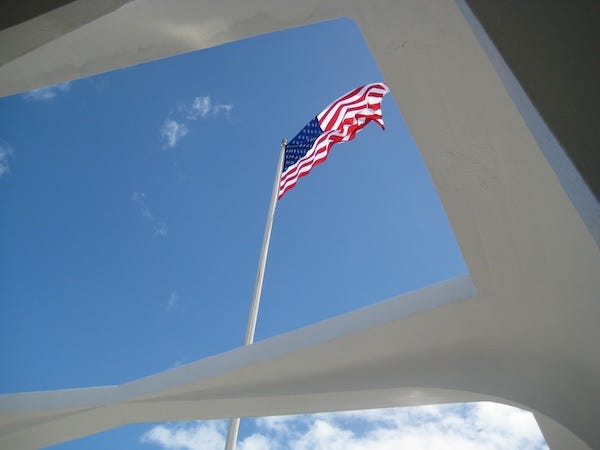
United States flag flying over the USS Arizona Memorial, Pearl Harbor
THINKING ABOUT:
Living in San Diego County, you’re aware of our military. You see people in uniform going to work at North Island, Marines off for the weekend from Camp Pendleton, fighter jets doing maneuvers over Miramar. We’ve had a neighbor who was on the ship that collected Osama bin Laden’s body and a Navy Seal who was an underwater demolitions expert removing mines from a variety of Gulfs in the Middle East. We’ve known helicopter pilots and doctors and communications experts. On any given weekend at the USS Midway Aircraft Carrier Museum you are likely to witness a military ceremony: promotion, retirement, or medal.
San Diego is unusual, as most people in the country aren’t near a base and only 3% of Americans live in military households. For most Americans, the military is an abstract concept or a rah-rah feeling. Marine maneuvers at Camp Pendleton often involve explosives which can be heard more than twenty miles away and sometimes rattle our windows in Oceanside. If you log onto NextDoor when this is happening, someone will inevitably—and unironically—comment, “It’s the sound of freedom!”
As a large country in a destabilized world, we need a military. But what we ask of our military is wrong. At Pearl Harbor, I felt the valor and the sacrifice. We had been attacked and had to fight back. On the USS Arizona Memorial, you are on an anchored platform floating above the hull of the ship where 1,177 sailors died. Those sailors died for our freedom and our democratic ideals. Had we lost that war, things would be very different today. (The Man in the High Castle provides a taste of that alternate reality.)
But recent wars are nothing like WWII. We send young, poor people with very few other options into battle over oil, or ego, or oil and ego. And the cost for that is the highest one possible, with a ripple effect that we should not ignore.
WATCHING:
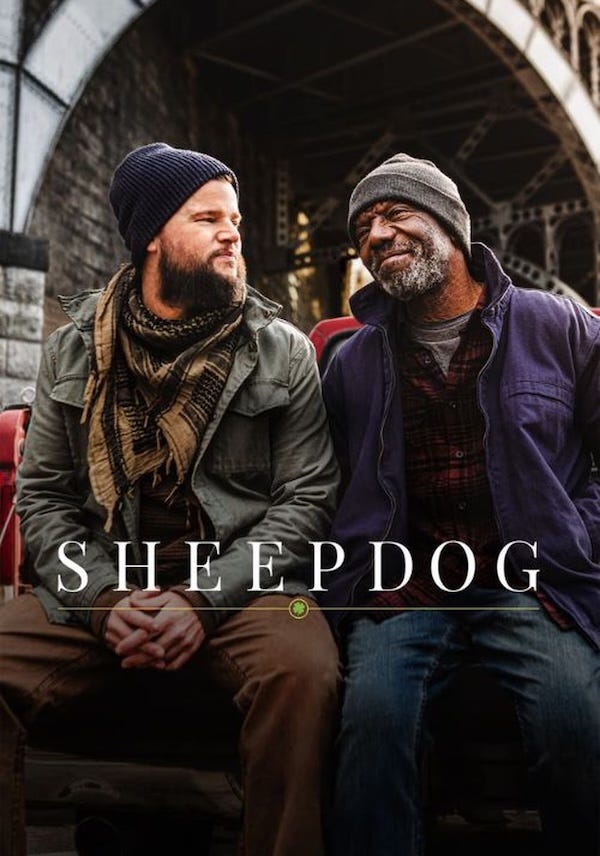
In Sheepdog, Steven Grayhm plays a vet with PTSD who is living a life wrecked by multiple TBIs in a Western Massachusetts town with a depressed economy. He so frequently looks and sounds like a young Matt Damon that they wrote it into the script. While there are better war films I could have chosen for this week’s note, I appreciated Sheepdog for its unsparing look at how soldiers are tossed aside and left to deal with the impact of battle on their bodies and psyches. This isn’t a glossy, heroic portrayal of a soldier, but of a man with a broken brain who finally might get some actual help. (Available to rent on a variety of streamers.)

READING: Alive Day by Karie Fugett
Alive Day is the military nickname for the day you almost die in battle. In this beautifully written, heartbreaking memoir, we meet narrator Karie Fugett, a girl who grows up in the hardscrabble South with lousy parents and no prospects. Her parents divorce, they move a lot, and she has difficulty connecting with people or seeing any future for herself. She falls in love with Cleve, a young man with a similar background who joins the Marines after the 9/11 attacks for a chance at a better life.
Cleve is badly injured on his first deployment. The majority of the book takes place during his agonizing recovery, rehabilitation, and separation from the service. Fugett pulls no punches in her assessment of how wounded soldiers and their families are treated, continually wondering what the sacrifice was for. The juxtaposition of celebrities who come to Walter Reed to have their photos taken with wounded vets and the treatment of the service members’ families is shocking. She gives a big shout out to the wonderful nonprofits who help fill gaps in care, payments, and services, but questions why our government can’t take care of its own. A sobering look at war and the deep impacts it has on the men and women who serve and the sacrifice their families make.
You'll find all of my book recommendations at my Bookshop. If you buy from this link the author makes more, an indie bookstore gets the sale, and I make a small commission. Win/Win/Win!
Catch up on all things Bitter, Sweet
Discovering & writing about long-buried feelings
Excerpt from the chapter: A Cop At My Door Bearing Jell-O Shots
My publishing process—on Memoirland
Ronit Plank & I talk about book structure & why I wasn’t writing a trauma memoir
Thanks for reading this week. Let’s hold each other close in this darkness, hold onto our empathy, and not give up working toward healing and justice.
Bitter, Sweet is now out! If you’ve ordered it, THANK YOU. If you can drop a one-sentence review on Goodreads or Amazon, a million thanks.
Bitter, Sweet is written by me, Stephanie Weaver, MPH an author and TED talk coach. No aspect of this post is created using any type of AI. I post for the delight of writing and connecting, hoping to add a bright spot to your week regardless of what’s happening in the world. No paywalls, ever. Support my work as a disabled writer with a $5 monthly subscription, or a one-time donation via Venmo.
I love hearing from you, whether that’s by email or in the comments where you’re reading this.
As a military spouse for 20 years, it hits me in the feels when those not directly connected to the military notice what’s happening in our community. I’m so glad memoirs like Alive Day have crossed over into mainstream because even tho 99% don’t serve, this is still America’s military. We all shape its funding and its usage in how we vote. I think it’s important for these stories to be told so citizens understand the impacts that high-level decisions have on the families at the bottom. All this to say, thanks for writing this!
Hi Stephanie, I heard your interview on Substack and found you authentic and refreshing. I am a memoir writer in Carlsbad and would love to meet for coffee. Vickibwrites@gmail.com